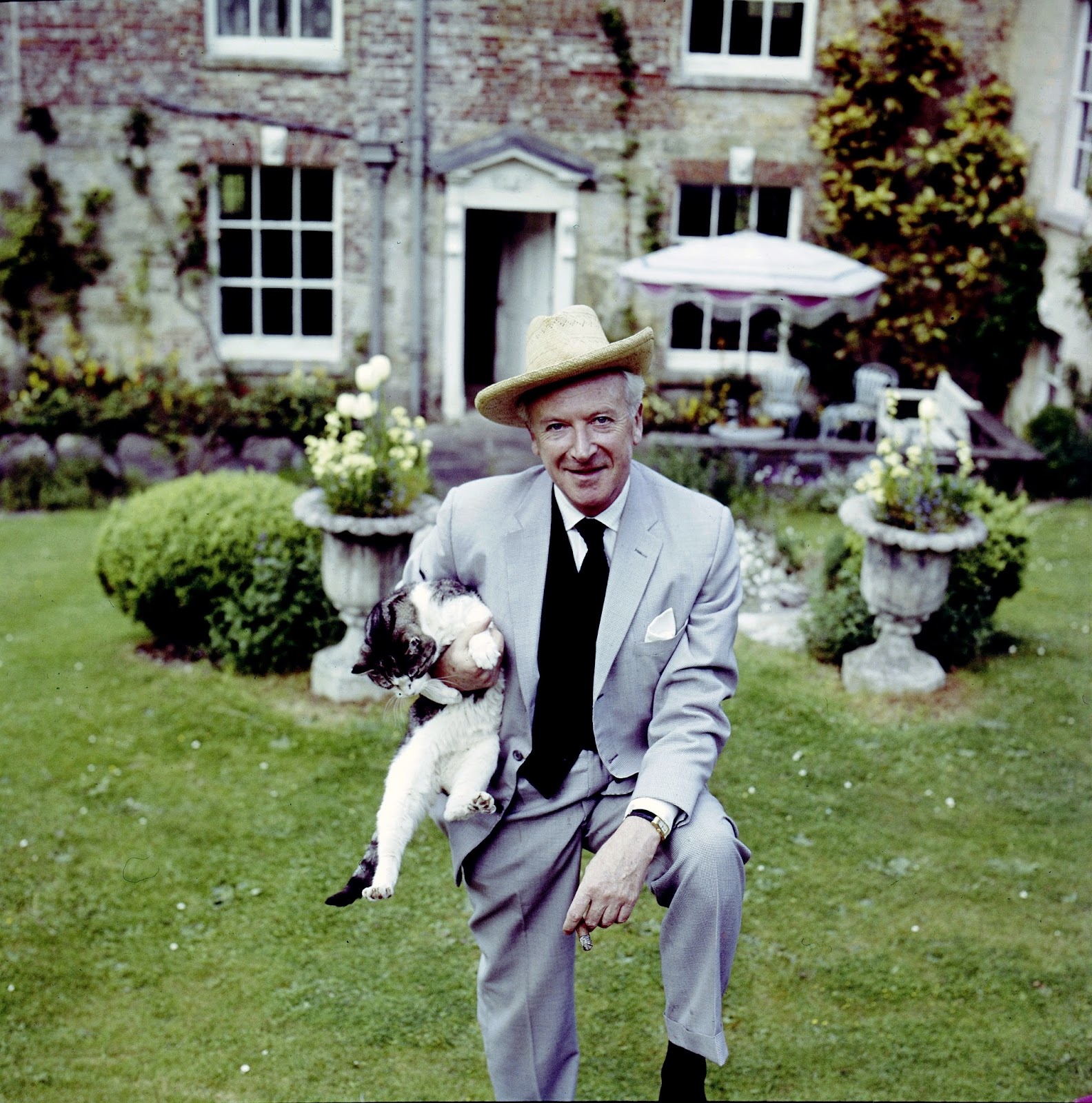
To listen to Beaton describe in strictly visual terms a person or
room or landscape is to hear a recitation that can be hilarious or brutal or
very beautiful, but will always certainly be brilliant.
A person sitting for Beaton has a sense of slightly drifting in
space – of not being photographed but painted, and painted by a casual, barely
visible presence. But Beaton is there, oh yes. For all his quiet tread he is
one of the most on-the-spot people alive: his visual intelligence is genius.
– Truman Capote, “Cecil Beaton”
(1969)
Since he wasn’t born into
aristocracy, money and stolen wealth, it might be argued that Sir Cecil
Beaton’s life began with a proper false start. He was in fact conceived at the superior
Hôtel Hermitage in Monte Carlo, and he did have a very happy childhood at home,
but to his great disappointment he was not a hereditary toff. As the versatile
artist told John Freeman when he was the subject of the BBC interview series Face to Face on February 18, 1962: “No
one could help me. It was up to me to find the sort of world that I wanted.”
In the MoMA publication Cecil Beaton: The New York Years Donald
Albrecht writes that, “Among other forces, like his originality and
homosexuality, Beaton’s fringe position instilled in him a snobbish obsession
with class and status – and a determination to be perceived as an artist,
rather than a member of the merchant class of his father. Like [Evelyn] Waugh,
it also made him an astute observer of speech, clothing, gesture, and pose as
signifiers of status.”
Cecil Beaton (1904–1980) was a
constitutional dandy and a socialite with an infallible sense for the visual
world and the truly marvellous. Alan Jay Lerner – who worked with Beaton on
both the stage and screen version of the transitional My Fair Lady – noticed that, “Inside Cecil Beaton there was another
Cecil Beaton sending out lots of little Cecils into the world.” He flourished
of course as a portrait and fashion photographer, he was an illustrator,
columnist, dress designer, art director, author, a decorator and set designer,
sometimes an actor, who ironically only failed where he most wanted to succeed,
as a playwright. The theatre was the love of his life.
Beaton maintained that his adult
vision was guided by his “inward child’s eye”. He took his idiosyncrasies with
him to fashion shoots, to warzones, and to the last bastion of the British
Empire when he redecorated some of the rooms at the Government House in
Calcutta, so that they “became slightly Edwardian, very feminine and almost
human”. Beaton’s enchanted admiration for the very feminine began when he was only three years old.
In his Photobiography of 1951, Beaton recounts how he “used to be allowed
to scramble in my mother’s large bed and nestle close to her while she sipped
on an early morning cup of tea and opened her letters. One morning during this
customary treat, my eyes fell on a postcard lying in front of me on the pink
silk eiderdown and the beauty of it caused my heart to leap.”
The picture was of the actress Lily
Elsie, whose “neck, in its full swanlike glory, was surrounded by an elaborate
filigree of diamonds, while her hair was piled in billowing clusters of curls.
To make the whole effect more unbearably beautiful, the photograph had been
tinted, the cheek and lips of this divine creature were of a translucent pink
that I could never hope to acquire from my box of crayons, and the tulle
corsage of her pale yellow dress was spangled with tinsel stardust. My passion
for Miss Lily Elsie and my interest in photography were thus engendered at the
same time.”
Beaton grew up in a nice house in
Hampstead in north London. He was born the same year as his grandfather died
and left a fortune of £155,000 (seventeen million pounds in today’s money) from
his company the Beaton Brothers. Cecil’s father (Ernest) took over the timber
business, but things did not go so well when road builders began to replace his
sleepers with modern pavement. It was not that Cecil hated his father, but he
could do without the whole masculine domain of circumstances and (as he told
John Freeman) his father’s “rather hearty friends that he brought home for
dinner on Saturday nights, all that meant nothing to me. That sort of laughter
in the billiard room was a world that I knew nothing about and had a slight
antipathy to.”
It is very telling how Beaton is
using a condescending tone to infantilise his father in Photobiography, and how he endows the women of his childhood with
joyous memories and recognition: “Although my father took photographs by
squeezing a rubber ball attached to an end of an umbilical cord affixed to a
largish camera of indefinite make, it was Alice Collard, my sisters’ nurse,
with her No 2 Box Brownie, who first brought any great enthusiasm for
photography into the family.”
The daily climax in his young life
was the fashion illustrations in the Evening
Standard, and the sensuality of daubing these rich plates with his
watercolours: “Sometimes, on red-letter days, Bessie Ascough sketched a picture
of a lady in court dress, replete with feathers, bouquet and train; or she
might draw a robe de bal, giving a
wonderful facsimile of all the embroidery of the dress. Her particular skill
was manifest in the roses that she drew, roses like balloons or billiard balls,
with great round centres.” His parents “deemed it” – as Beaton put it in The Glass of Fashion (1954), his
successful and very original summary of dress culture, and of the real
shepherds of fashion, in the first half of the 20th century –
“unwise to allow these apoplectic expectancies to continue: the child was
becoming peculiar.”
One such peculiarity was his “keen
perverse enjoyment in scrutinising photographs of stage scenery. The more
blatantly these showed the tricks and artifices of the stage, which would never
be obvious to a theatre audience, the greater the pleasure [Photobiography].” Cecil’s brother (Reggie)
committed suicide at a young age so his two remaining siblings, Baba and Nancy,
were quite on the feminine side of things – though “they were rather ugly little
schoolgirls” who he transformed in his own designs of camp glamour and
photographed them against his contrived backgrounds.
“Cecil Beaton was an artist who
took the artificiality of photography and, by exaggerating it, made it into a
medium for telling the truth,” writes Wendy Lesser in His Other Half: Men Looking at Women Through Art. She is also right
in that Beaton always “insured that his photographed world would not visibly
resemble our daily world. Despite this, his pictures comment trenchantly and
enduringly on the reality to which they bear such an oblique relation.”
The only thing he didn’t approve of
about his elegant mother was that her father was a common blacksmith. He
flaunted his folly by presenting her and other women of his young life as
society ladies in the London papers. Mother Etty was at times an inspiration of
artifice in the way she dressed: “On one occasion she wore a large special
bunch of imitation lilies of the valley on her bosom, pinned to a green chiffon
scarf. This sunburst of artificial flowers was a revelation, because I had not
thought lilies of the valley could be simulated [The Glass of Fashion].”
But when it came to artifice and irreverent
extravagance, the full monty, Beaton got all he could ask for of inspirational
festiveness from his one and only aunt who “relished the fact that her
appearances involved hours of preparation” and who overdressed for all of her
minor entertainments: “To Aunt Jessie I own my first real glimpse of the world
of fashion, of that whole grown-up world from which a child is so often
excluded,” he wrote. “Aunt Jessie was the outsider, the magic relation who
provided those special treats and fantasies that are so dear to childhood. She
made one feel that one went back to reality after leaving her [ibid].”
In the television documentary Beaton by Bailey (1970), which was “hosted”
by big-name photographer David Bailey but directed by Bill Verity, Diana
Vreeland (editor of American Vogue at
the time) says something that rings very true: “You see, what I like about
Cecil is that he has a great deal of the outrageous in him, he insists on the
outrageous.” All that derring-do that distinguished Cecil Beaton did not fair so
well when he had to face up to the realities of the British school system and the
ruffians that would become the ogres of the country’s establishment. At age seven
he was inevitably dragged into Heath Mount School and into the uncharted world of
boys and scrotum hormones: “Suddenly out of nowhere the bullies arrived. They
had recognised the quarry in me. Growling like wire-haired terriers. They were
large and solid, with hairy stockings and rough tweeds.”
His primary bully was Evelyn Waugh,
who he nonetheless photographed in 1955 with a fence and a warning sign between
them: Entrée interdite. (“He thinks
that I am a nasty piece of goods, and – oh
brother – I feel the same way about him.”) Beaton was something of a dud in
school, and he never learned the things you are expected to learn (nor did he
read a book until he was eighteen), but “Absolutely, everything about him was
an aesthete,” as Cyril Connolly remembered their time together at the repugnant
St Cyprian’s School in Eastbourne. “He lived for his feelings and his response
to art, and in his case it was the theatre.”
The sport was to get in favour with
the sadistic headmistress (known as “Mum”) of this seaside establishment, for
the simple matter that it would provide a chance to make life worth living.
Beaton felt ashamed by his horrible tactics, but as he expressed it in an interview
decades away from St Cyprian’s: “I suppose in a way it was really good training
for later in life.” In Enemies of Promise
(1938), Connolly recalled his semesters with his two schoolmates:
“[George] Orwell proved to me that
there existed an alternative to character, Intelligence. Beaton showed me
another, Sensibility. He had a charming, dreamy face, enormous blue eyes with
long lashes and wore his hair in a fringe. His voice was slow, affected and
creamy. He was not good at games or work but he escaped persecution through
good manners, and a baffling independence. We used to mow the lawn together
behind an old pony, sit eating the gooseberries in the kitchen garden or
pretend to polish brass in the chapel; from Orwell I learnt about literature,
from Cecil I learnt about art.”
Next was Harrow, the straw-hat private
school in northwest London, where he was allowed to show his talents in art
class. Apart from that “I just felt, to begin with, that I didn’t like that
sort of herding together,” Beaton told Freeman in the BBC programme. “I hated
the stink of the swimming bath in the morning, and it took me some time to find
some congenial friends, people who hated it as much as I did.”
What began in the autumn of 1922 were
a number of years of advanced social development at St John’s College – without
any kinds of academic achievements – where Beaton, rich in determination, proved
himself well adapted to develop the town’s theatre life and the hedonism inside
Cambridge University.
“I was thrilled by the fact that
certain people would give up life to aestheticism,” he wrote in his diary that
became his many famous diaries that lasted from 1922 to 1980. “Cecil treated
the published diary in much the same way he treated his published portrait
photographs. He retouched them shamelessly until he achieved the effect he
sought,” writes his biographer Hugo Vickers in the foreword to The Unexpurgated Beaton: The Cecil Beaton
Diaries as He Wrote Them, 1970–1980. “Thus, in the published diary,
opinions are softened, celebrity figures are hailed as wonders and triumphs,
whereas in the originals, Cecil can be as venomous as anyone I have ever read
or heard in the most shocking of conversations.”
Photography authority Philippe
Garner has expressed that “Cecil Beaton cast himself as a dandy not just in the
superficial sense of one who paid undue attention to his clothes and grooming,
but in the more complex sense of one who desired a role for himself as the
eternal outsider.”
In Cambridge, Beaton “set about to
become a rabid aesthete”. What is known is that Beaton’s student pad was the
most lavish in town with the walls painted in cerise, gold furniture and every
other detail in emerald green, including his lovebird. He looked like a punk
Quentin Crisp, with varnished nails, lipstick, eyeliner, earrings, necklace and
a big hat. One of his opulent roles was at the ADC Theatre where he designed
almost every bit for the Footlights Dramatic Club and also performed in their plays
and revues.
“Your inspirations are what will
make your photographic life exciting. And your desire for recreating beauty
will overlook all forms of hard work and discouragements,” Beaton said in 1938.
His photography saved him from what he feared the most – “the creatures of the
commonplace, the slaves of the ordinary” – a life less extraordinary. His
father was paying a Holborn office a pound each week after Cambridge just for
putting up with his objectionable son. Cecil was drowning like a fish on dry
land.
He went to Venice in the summer of
1926 and then befriended the (untalented) super aesthete Stephen Tennant in
December, who introduced him to some of the greatest artistic leaders of the
era, the siblings Edith, Osbert and Sacheverell Sitwell. And from there on Beaton
could allow himself to be conscious that the things he did were the things he
had always wanted to do.
“I became a great good friend of
the three of them,” Beaton says in Beaton
by Bailey. “And through them I think I got my first foot into the door of
the sort of life in London that I really was craving for. My name became really
quite well known in various strange ways. An uncle came to dinner one night,
and he said that he had been to a vaudeville theatre in Edgware Road and some
red-nosed comedian had ended his act by saying, ‘I am just going off to be
photographed by Cecil Beaton.’”
The diary entries became markedly
less fervent in February 1927. Beaton had suddenly got so much to do,
photographing his famous new acquaintances, designing fancy dresses for the
Bright Young Things and doing a wide range of work for Vogue in Britain.
Evelyn Waugh caricatured Beaton as
the photographer and social climber David Lennox in his first novel Decline and Fall in 1928. “Forty-five
years ago, photographers weren’t thought of as being particularly eminent,”
Beaton told Freeman in 1962. “I took these photographs that were considered
revolutionary and fantastic, and I had an exhibition of them. And from the
moment the show was on they just clicked because there hadn’t been celebrity
photographs in that particular way.” The booming show was at the Cooling
Galleries on Fleet Street in 1927. The success was repeated three years later
in connection with the publication of his first book, The Book of Beauty.
In 1928 Beaton stepped ashore in
New York (“there were crowds waiting to welcome everyone but me”) with fifty
pounds in his pocket and a letter of introduction from the Sitwells. On this
first stay he met Bessie Marbury – who was the great literary agent and theatre
producer of the time – and he met her former lover, Elsie de Wolfe, the widely
known socialite who is regarded as the first professional interior designer. (“She
is the sort of wildly grotesque artificial creature I adore,” penned Beaton in
his diary.) de Wolfe doted on the meticulously attired young man with his mannerisms
and natural endowments. She presented an exhibition of his illustrations in her
gallery on Fifth Avenue, Beaton’s first in New York.
When Beaton came back to London he
had signed a “lifetime” contract (which lasted until 1955) with Condé Nast. It
says a lot about Beaton’s disinterest in the technical side of photography that
he still worked with the Kodak pocket camera that he got from his parents on
his twelfth birthday when he made the acquaintance of Edna Woolman Chase, the
long-standing editor of American Vogue.
Nast got him into working with a Rolleiflex and a big studio camera (which he
did not know the name of), though he never had a studio of his own. Beaton
wanted to remain an amateur in the
same sense as Orson Welles used the word: someone who loves what he does.
It was common practice that Beaton
talked about his photography in past sense, however: “I wasn’t very interested
in the sitters themselves. I wanted to make pictures with the camera, I wanted
to make something that didn’t really look like a photograph,” he told Freeman.
In a very good interview with Rosa Reilly in the April issue of Popular Photography in 1938, Beaton signalled
that he still was looking for the end of the rainbow.
And he was comparing photography to
a fancy dress party: “I think this medium suited me extremely well for the
years in which I happened to be in the frame of mind to do camera work.
Photography gave me a tremendous amount of results. Just as in that period I
loved parties madly, used to stay up all night and dance frenziedly – I gave
fancy dress parties and behaved hysterically. Photography was all a part of
that life. But I find that one can have too many costume parties.”
Anita Loos joined Beaton in New
York in the winter of 1929 and they travelled to Los Angeles together. Beaton’s
mission was to photograph the actresses of Hollywood for Vanity Fair and to fill up The
Book of Beauty. Beaton took Hollywood by storm and he spent the New Year
with Mr and Mrs Rosebud at their San Simeon palace north of Los Angeles.
Anita Loos was Beaton’s best friend
in Hollywood and she opened a whole lot of doors for him there. “My first
impressions of a film studio were so strange and fantastic that I felt I could
never drain their photographic possibilities,” Beaton wrote in his diary. “The
vast soundstages, with the festoons of ropes, chains, and the haphazard
impediments, were as lofty and awe-inspiring as cathedrals; the element and
paradox and surprise was never-ending, and the juxtaposition of objects and
people gave me my first glimpse of Surrealism.”
His first visit to Hollywood was
also a clandestine attempt to find the woman who he wanted to make his wife,
Greta Lovisa Gustafsson. He did not photograph Garbo until she appeared in his suite
at the Plaza Hotel in New York in 1946 – five years after she had abandoned her
acting career at the age of thirty-six – and they talked about a life together
that would involve the chance of facing each other in pyjamas each morning. “She
is as beautiful as the aurora borealis,” he wrote in 1937. “Her nose is so
delicate and sensitive that she seems to be conscious of perfumes too subtle
for others to enjoy.”
A few of the portraits from this
sitting are in the splendid Beaton retrospective Cecil Beaton – Master of Photography – which covers his portraiture
from the late 1920s to the early 1970s – at Sven-Harry’s Art Museum in
Stockholm. The walls in the exhibition are colour coded: a dull ice-cream green
for the artists, generic gallery-white for the actors and actresses, while the
blue room is a mixed bag of portraits. One would have wished a much more daring
choice of colours – Beaton, for sure, would have sneered “retina irritant” –
but the quality and the verisimilitude of Beaton’s props-and-people fantasies really make these images speak
for themselves.
Truman Capote: “There is almost no
first-rate contemporary photographer of any nationality who is not to some
degree indebted to Cecil Beaton. Why? Look at his pictures.”
Photographer Patrick Anson said of
Beaton’s pictures that “The extraordinary thing is that he is really a diarist
of what our world has been.” The fact that the exhibition is full of genuinely famous
faces that few will recognise today (and heaven knows he absolutely met and
photographed them all), makes one kind of extra dreamy and humble and yearning
in front of many of the portraits at Sven-Harry’s.
One of the earliest pictures in
Stockholm (and an exception as it’s not a vintage print) is his silvery
portrait of the London socialite Paula Gallibrand from 1928, with her oval
Modigliani face and lovely round belly. A note from Beaton’s diary: “For
beauty’s sake she should never smile her peculiarly ludicrous smile, but for
humanity’s sake she does and should. There is no more reassuring or nicer
smile.” Sail on, silvergirl. Your time has come to shine again.
Beaton had too much of the theatre
in his mind in the 1920s to be a really great portraitist. Many of his pictures
from this decade are loud of everything but the sitter. A classic Beaton that
is missing here is his portrait of Stephen Tennant as Prince Charming on lit de
parade (1927). But the only picture that is truly missing in the show is the
pinnacle of all Beaton’s photography: his haunting and heartbreakingly beautiful
en face portrait of the traumatised Romanov princess Natalia Paley (1935) where
he so much mastered the shadows and erased the right side of her face. A
bouquet of flowers is growing out of her chest. Boris Vian put a surrealistic
water lily – and the same suffering and sorrow – in Cloé’s lung twelve years
later in his novel L’Écume des jours.
Beaton designed for the stages in
London throughout the 1930s, but it was as a photographer that he thrived.
Surrealism and his work for Vogue were
two things that made photography the centre of his creativity. As Donald
Albrecht argues in his book about Beaton’s life in New York: “As the 1930s
progressed, Beaton’s romantic sensibility remained perfectly attuned to the
era’s equally romantic fashion aesthetic. But Beaton also brought something to
the magazine they did not: his interest in avant-garde art movements like
French Surrealism and his witty Bright Young personality in the form of
illustrations and articles that gave Vogue’s
American readers a distinctly British slant on the two countries.”
The city itself supplied him with
the necessary energy for his incessant advancements in photography: “When I
think of the work I have done in photography I am often weary of it but I know
I shall never give it up,” he told Rosa Reilly in 1936. “Particularly in New
York would it be impossible for me not
to take pictures. New York is like electricity. The efficiency and vitality of
all America is transmuted to me here. The tempo is so fast I can’t paint or
write – or even read. But it makes me photograph as madly – as frenziedly as
ever I danced at fancy dress ball.”
He stayed at the Waldorf Astoria,
the Ritz-Carlton and the Ambassador when he worked in New York. His beloved home
at home was an old farmhouse in Wiltshire (near Bath), which he transformed
into a dreamworld for his tastes – featuring an exceptionally delightful circus-themed
master bedroom designed by Rex Whistler with a ravishing unicorn poster bed –
and which he wrote a book about some years after the contract ran out, Ashcombe: The Story of a Fifteen-Year Lease (1949).
It is a miracle how he managed to do all the things that he did, and with such a
steady flow of quality and vitality. Beaton was like the feline in Wilde’s cracking
epigram: “If you want a lesson in elaborate artificiality, just watch the
studied unconcern of a Persian cat entering a crowded salon.”
In the excellent portrait book Cecil Beaton: Portraits and Profiles,
Hugo Vickers writes how Beaton “pandered to their egos while riding on their
coat tails” (sometimes it was the other way around with the celebrities). The
British royalties began to call for him. “In the 1930s, many British aristos
found themselves unable to keep their right arm vertical. Like their fellow
nobs in France, Prussia and Spain, they clung to Fascism as an antidote to
democracy and in the hope of keeping their loot. Nazism’s whack ball theories
of racial hierarchy chimed with toffs’ daft belief in natural aristocracy and
breeding,” writes Glen Newey on the LRB
blog (July 21, 2015). “And there was the Lady Elizabeth Bowes-Lyon, in later
years the dear old ‘queen mum’, whose tastes in booze, cloche hats and
ultra-rightist politics had already ossified in the early 1930s.”
Beaton had no issues with the
court’s offensive arm stretches or Wallis Simpson’s friendship with the Führer.
In February 1938 he stabbed American Vogue
in the back. The damage caused by a sketch that he had produced with a punch
line about “dirty kikes” was substantial, and the magazine removed and
reprinted what remained of the 150,000 copies that had been distributed to the
newsstands. Beaton’s response to the Vogue
debacle was his regular stance of studied unconcern. But it was, quite ironically,
his royal engagements that once more would open the doors for him at Condé
Nast.
Baudelaire was the first to realise
how dandyism was in opposition to aristocracy and at once its refiner. Beaton
was a snob, but he was a real snob.
He portrayed many of the narrow-minded aristos he didn’t like as single beings,
whereas he often used mirrors or montage to multiply a person whose charms and
talents he adored in a single frame (as with his great portrait from October
1972 of the three Charlotte Ramplings). Sven-Harry’s offers guided “queer”
tours for the crowns of Swedish PC dogma but nothing of the kind for white
heterosexual males who have been deprived of every right to exist. Welcome to the
most equal nation in the world, some of you.
The forward-thinking brilliance of
Beaton’s unconventional fashion photography, in which he pictured his smartly dressed
models as they were idling in unglamorous settings with his added miscellaneous
everyday articles for surreal effects where the viewer had to fill in the
blanks, was mostly more of a nuisance for American Vogue at the time. The pictures from his 1937 session among the
cement and the debris of a construction site on the Champs-Elysées barely passed
the magazine’s restrictions but became widely imitated by others.
“Fashion photography has become
altogether too genteel and refined to suit me. I want to make photographs of
very elegant women taking grit out of their eyes, or blowing their noses, or
taking lipstick off their teeth. Behaving like human beings in other words. Not
women who are always on the crest of the wave,” he told Rosa Reilly in Popular Photography. “It would be
gorgeous instead of illustrating a woman in a sport suit in a studio, to take
the same woman in the same suit in a motor accident, with gore all over
everything and bits of the car here and there. But naturally that would be
forbidden.”
There are two Churchills in the exhibition.
Beaton photographed the surly Prime Minister at his writing desk at 10 Downing
Street in November 1940: “The PM settled himself and stared into my camera like
a bulldog guarding its kennel. Click!” His niece Clarissa Churchill looks as if
she carries the whole world on her shoulders, but the only “props” in this
classic portrait from 1949 are her gloves, with one of her hands bare. It
feels like you could tell how much Beaton liked a person by how much he accentuated
the sitter’s hands. Beaton was wonderful with hands. They were two extra faces.
From March 1942 to July 1944,
Beaton served for the Ministry of Information and photographed the fall of the
British Empire in Egypt, India and China in his own peculiar fashion. “The
entwining of Beaton’s social conservation with his sexual self-fashioning had
significant consequences for his representation of British masculinity during
the war,” writes Martin Francis in Penultimate
Adventures with Britannia: Personalities, Politics and Culture in Britain.
Beaton’s cheesecake pictures of Johnny Weissmuller had proved too much for MGM in
1932 – such excursions aside, “he usually preferred to develop his bohemian
queer aesthetic more covertly”.
Picasso had not been able to
concentrate on his work for months when Beaton met him at 7 rue des Grands
Augustins in November 1944, due to the great number of GIs who descended on him
after the Liberation of Paris. He photographed Picasso sitting on the edge of the
studio’s bathtub in a fine suit, away from everybody in his modest bathroom
sanctuary. Beaton was going the other way. “Now, with nothing specific to keep
me in England, there was time to settle down and relish to the full infinite
delights that New York has to offer,” he confided to his diary in 1946.
In England he had a secretary, a
chef and others who followed him between his home at 8 Pelham Place in
Kensington and his mansion Reddish House near Salisbury. “Cecil created
illusions,” explains his biographer. “His day began early and he worked in bed.
He might be checking page proofs, selecting photographs, writing his diary, or
talking on the phone, and he would not rise until shortly before his first
appointment. If, for example, he were going out for lunch, he would shave and
dress just before going out, thus arriving looking fresher and more
clean-shaven than the other guests who had been out all morning. He liked the
image of Renaissance man or man of leisure. It was deceptive. He had been
working very hard indeed.”
In 1953 he photographed Elizabeth
Taylor (“this monster,” he called her in a diary entry from 1971, “this great
thick revolting mass of femininity in its rawest”) – it was obvious that Beaton
did not nourish the same hope as Warhol to be reincarnated as the greatest
diamond on her ring finger – and he photographed Elizabeth II in her coronation
robes against a fake backdrop of Westminster Abbey during a three-hour session
at the Buckingham Palace:
“The Queen stood looking very
inanimate and it was for me now to keep her alert and amused. Luckily it seems
to me that the Royal Family have only to get a glimpse of me for them to be
convoluted with giggles. Long may that amusement continue for it helps
enormously to keep the activities alive. Throughout the afternoon I found that
it was very easy to reduce the Queen to a condition of almost ineradicable four ire and thus prevented many of the
pictures looking sullen or morose [1955].”
Five portraits from the sitting
with Ingrid Bergman in 1958 are in the exhibition as well, and they serve as a
great reminder to go and see Stig Björkman’s no-nonsense documentary I Am Ingrid (2015). Beaton’s 1955 portrait
of the eighty-year-old Bernard Berenson (with one hand grasping his walking
stick and the other posed in front of him) in the centre of an avenue of lime
trees is lovely. “I was impressed by the fact that age could not wither
Berenson’s interest in life and people,” Beaton remarked for himself. “As he
commented on the beauty around him, I was aware that, in his company, life took
on added intensity.”
TS Eliot’s hands are as dominant as
his face in Beaton’s superbly composed picture of him, in which the reflections on the writer’s glasses and on the rippled window behind his back make all the
difference. Beaton met Marilyn Monroe in a New York hotel suite in 1956. “If
this star is an abandoned sprite, she touchingly looks to her audience for
approval,” he wrote – adding: “It will probably end in tears.” Beaton found this
sprite very easy to like, and “I was so impressed by the sort of gaiety and the
variety of moods that she had that I just wanted to catch that, so I did not
concentrate on the background at all.” Beaton’s photography became less and
less showy and opulent the more he worked within the theatre, opera, ballet and
film, the closer he came to the end his rainbow.
Nancy Hall Duncan mentions in The Berg Companion to Fashion that
Beaton “had an exclusive knowledge of Victorian and Edwardian photography and
drew for inspiration on the costume depiction of such 19th-century
portrait photographers as Camille Silvy and the collaborators DO Hill and
Robert Adamson. He was also inspired by the soft-focus technique of the
photographer EO Hoppé, the opalescent lighting of Baron Adolf de Meyer, and
conventions of English portraiture and Renaissance painting.”
Beaton received his first Oscar for
Gigi in 1958 (for Costume Design) and
his second and third in 1964 for My Fair Lady
(also for Best Art Direction). In the 1954 November issue of American Vogue – before he switched to Harper’s Baazar and other magazines – Beaton
had described Audrey Hepburn’s stance as “a combination of an ultra fashion
plate and a ballet dancer”. (She was a kind-of ballet dancer as much as she was
a kind-of actress.) The portrait at Sven-Harry’s shows Hepburn in her “lady”
costume, though she was so much prettier as the Covent Garden flower girl.
Another little butterfly stuck on the pin.
(Beaton photographed the other Hepburn in 1936, but they despised
each other unreasonably. As Vreeland expressed it, “He picks his enemies
beautifully, doesn’t he?”)
Wendy Lesser: “The musical comedy
based on Shaw’s Pygmalion was in any
case a perfect vehicle for Beaton, as a male photographer who repeatedly
transformed hired models into exclusively dressed ladies, he was well equipped
to understand the myth of Pygmalion and Galatea.”
The National Gallery in London had
a great exhibition of his work in 1968 called Beaton Portraits. The 1960s were inevitably an era with people who
liked to behave badly – the Rat Pack, the Rolling Stones, Warhol with his
entourage of fuckups – but if you want someone who actually rebelled against
something then look at the picture that Beaton took of Rudolf Nureyev in 1962
(the year after he had defected to the West), just out of the shadows and what
a star.
The portraits he took of Twiggy in
his London home are conventional girlie Twiggy pictures and they are only
interesting because they show a little of the inside of 8 Pelham Place. Barbara
Streisand was another thing. She was only twenty-one when Beaton made her look
like a woman in a classic Nefertiti representation made in Hollywood in 1963.
Streisand has remained very thankful
for what Beaton did to her: “When I started in the 60s, the beauty symbols were
young girls like Sandra Dee. Cute blondes, with little turned-up noses. And a
lot of people, including my mother, didn’t think I’d ever be a movie star. And
it was quite a thing for me, all of a sudden, to have Cecil Beaton say he
thought I was one of the most beautiful women in the world. It was great. I
mean, he liked the bump on my nose.”
“She reminded me of Edith Sitwell,”
Beaton noted in the diary. “Sitwell and Streisand – both were very willing to
experiment, even willing to compromise. Classically beautiful women are seldom
willing to experiment. They are less evolved, because the mirror and the man
tell them they’ve reached a state of perfection, never mind that it’s subjective
and entirely physical.”
In the 1970s Beaton photographed
Diana Vreeland (“Everything about her features is animated by amused interest”),
he photographed Gilbert and George and created one of his very best pictures, showing
the couple as they pass or caress or threaten each other at the black-squared cellar
entrance at Pelham Place, and he photographed David Hockney in his not best
choice of outfit. In Beaton by Bailey,
Beaton is taking random pictures of Hockney in front of his almost finished
masterpiece Mr and Mrs Clark and Percy
(1971).
In this documentary, Truman Capote
is full of words and hidden praise for Beaton: “Cecil’s own vision of himself
is that he has a great deal of grand seigneur about him, and he is both very
vain and very modest at the same time. And he has social vanity, which is
amusing and unique and I like it, it is part of his charm. He has great
certainty about himself in all social situations.”
But Beaton wasn’t sure about himself
in 1970. The diaries make known of a man who is tortured by excruciating
headaches and not a little self-doubt. In 1974 Beaton suffered a severe stroke
that partially disabled him. He was brave but things were not the same anymore.
When he died six years later he had lived for seventy-six years and four days.
As the two photographers sat down at
Reddish House, chatting like old chums in his Pierre Paulin chairs, Beaton told
Bailey in his nasal, creamy dandy tone: “If I can look animated there is some
hope for all of us. Otherwise it is just too depressing.”
Cecil Beaton refused to be bored
chiefly because he wasn’t boring.